


Short history of medicine
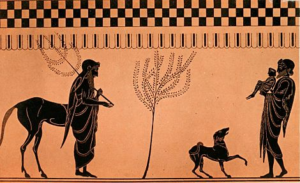
Centaur Cheiron: stepson of Apollo, he represents wisdom and the art of living. He educated gods and heroes, among them the God of medicine, Asclepius. Ch
The origins of medicine go back to the beginnings of the human experience on Earth and unsurprisingly, it has been plants with their active constituents hidden in their leaves, stems, flowers, barks, seeds and roots that have made therapy possible. HK18, HK21. In reality, up to the 2nd world war, medical practice across the world was based almost exclusively on plants. According to the World Health Organization WHO1 the majority of the population globally uses Traditional and Complimentary Medicine, and about 80% in the developing world still depend on herbal knowledge for their primary care.
So let’s have a quick look at the historical evolution of medicine. From the ancient civilizations of China, India, Mesopotamia, Egypt and Greece to the herbal traditions in Africa, the Americas and elsewhere, people developed their own understandings of disease and treatment and despite their differences they share many interesting common perceptions about health. Modern medicine is based on the ancient Greek tradition set by Hippocrates (460-377BC), a renowned Greek physician (Asclepiad), who combined the Pythagorean philosophy with careful observations and rational interpretations relating to diagnosis and treatment. Medicine escaped the spheres of religion, magic or metaphysics and entered the sphere of scientific thought and practice. Hippocrates conceived body, mind and spirit as a whole, whose balance is based on the balance of an individual’s four humors or qualities, named black bile, yellow bile, blood & phlegm. These humors relate to Nature’s 4 elements (earth, fire, air, and water respectively) and in a way describe the dynamics of bodily fluids, solids and gasses. Hippocrates’s holistic approach is based on systematic observations of human physiology and temperament in relation to Nature and believes that the doctor’s aim is to restore the optimum for a specific individual balance. This approach shares a lot in common with other traditions such as Traditional Chinese Medicine (TCM) and Ayurveda. The clinical and ethical framework of medical practice, many medical terms as well as the famous medical vow of Hippocrates have their origins then.
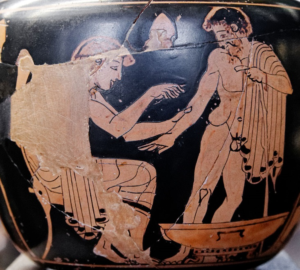 An innovative figure of the 1st century BCE is the Greek Asclepiad of Bithynia, who was the first to distinguish between Acute and Chronic situations and he performed the first elective (non-emergency) tracheotomy. He supported natural and painless interventions to cure his patients such as diet, exercise, bathing and music therapy. He refuted Hippocrates’ clinical method of observing phenomena and developed a new theory of medicine based on the atomic theory (formed and followed by the ancient Greek philosophers Leucippus, Democritus and Epicurus in the 5th 4th & 3rd centuries BCE), randomness and evolution, and which resembles an early version of molecular medicine. AB
Later on, in the 1st century CE, the Greek doctor, pharmacologist and botanist Dioscourides writes his 5 volume Materia Medica, where he describes the medicinal properties of plants and which influenced pharmacology for 15 centuries. In the 2nd century CE, Galen, the famous Greek doctor of Roman times, became a cornerstone of medical science. He was a doctor, surgeon and philosopher who wrote extensively on medical matters and influenced several scientific disciplines including physiology, anatomy, neurology, pathology, pharmacology as well as philosophy. At the turn of the 10th – 11th century CE, an Iranian polymath, known in the west as Avicenna, is regarded as one of the most significant physicians, astronomers and philosophers of medieval times. His Canon of Medicine, often revised, became the centre of medical teachings in European universities up until the 17th century. He continued the Hellenic tradition combining a Neoplatonian, especially Aristotelian philosophy with elements of Islamic theology. He wrote hundreds of works in many subjects, and out of the 240 that survive, 40 are on medicine.
There have been, of course, other important figures before and after, who complete the picture of the evolution of medical science. From Renaissance onwards technology allowed a big breakthrough with the discovery of the microscope and thus, microorganisms. Later on we have new developments in surgery (after ending the medieval taboo of dissecting human bodies), the discovery of anesthesia and of course, advances such as the discovery of X-rays and the invention of medical scanners.