


Holism vs Reductionism

Asclepion, Kos
Ουκ ένι ιατρικήν είδέναι, όστις μη οίδεν ό τι εστίν άνθρωπος.
It is not possible to know Medicine, if one does not know what a human is.HIPPOCRATES, 4ος BCE.
Health is a state of complete physical, mental and social well-being and not merely the absence of disease or infirmity. Preamble to the Constitution of the World Health Organisation as adopted by the International Health Conference, New York, 19-22 June, 1946. APA
The controversy between a holistic and a reductionist approach in medicine is, in fact, absurd; medical science is (or should be), by default, holistic, since it aims at the restoration of the health of an entity (the patient), even if it needs to encompass reductive methods. However, modern medicine evolved within a strictly reductionist way of thinking based on Descartes’s method of reducing a complex system to its parts in order to analyze it. This method has proven very useful in certain cases and should be considered compatible with holism, which is the essence of medical science. RW Specialization has a lot to offer, and in Public Health Systems we should support and incorporate expertise in specialized areas. Medical science has seen magnificent developments, which can by no means be undermined.
On the other hand, an over reductionist approach in medicine is shown to hide important dangers, such as oversimplification, confusion over cause and effect and arousing mistrust. MB The prevalence of overspecialization is too often proving its inefficacy in treating human beings as living organisms, which embody the amazing complexity of life. The ancient Greek (and not only) understanding that it is lifestyle that defines our state of health, has been overruled by a reductionist approach of attributing problems to uncontrollable factors (genes) and treating symptoms superficially, as if they are the problem to be tackled (whereas symptoms are just the expression of underlying causes). Furthermore, modern greed and corruption, has led to unethical practices such as unnecessary surgeries and the excess of prescription drugs being used; a study at Harvard University published in 2014 shows that prescription drugs are the 4th cause of death in the USA, whereas another study at John Hopkins School of Medicine published in 2016, shows that medical errors are the 3rd leading cause of death. HA JH
It has to be clear that medical practice is based on medical philosophy, which is the discipline that deals with conceptual, metaphysical, epistemological, methodological, and axiological matters such as the definition of health and disease, or epistemological issues regarding causality and diagnosis. HPM As stated in the Handbook of Medical Philosophy, the discussion on such issues is, indeed, necessary in order to face many difficult social and ethical issues in health care. Within this framework of advances in the conceptualization of health issues, the EURACT, the European Academy of Teachers of General Practice, in their definition of GP/FM (RH1) have identified ‘holistic modelling’ as one of the ‘six core competencies of the GP/family doctor’. They defined it as ‘the ability to use a biopsychosocial model (Engel’s RH2) taking into account cultural and existential dimensions’, and states that the model ‘deals with health problems in their physical, psychological, social, cultural, and existential dimensions’. RH3
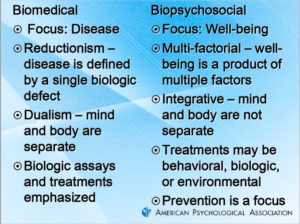 Medical Herbalism has always functioned within a holistic, biopsychosocial framework, and combines clinical evidence and scientific research with empirical data and traditional knowledge and understandings. The essence of evidence-based medicine is also to care for individual patients by combining empirical data with the best available external clinical evidence from systematic research (Sa97). The increasing acknowledgement of the importance of a holistic, patient-centered approach is attested in a paradigm shift occurring in medicine, where the biomedical model is challenged by the biopsychosocial model. APA It is indeed crucial to realize the important role psychological and social factors play in health. With the rising health problems in our modern life-style the need for interdisciplinarity is stronger than ever. Many doctors have adopted a holistic approach and sought solutions in Herbalism and other traditional & complementary medicine such Ayurveda, homeopathy and acupuncture; their concerns about allopathic medicine include the increasing lack of freedom in practicing their profession, the dependence on often untrusted clinical evidence promoted by pharmaceutical companies, the antithesis between supposedly clinical results and what their patients experience and the conflicting information within the literature and the results of clinical research.