


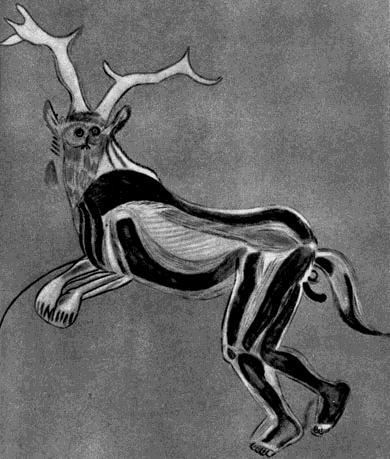
Sketch of The Sorcerer by Breuil
The word phytotherapy comes from the Greek words a) ‘phyto’ (= plant; the verb ‘phyo or in passive phyomai’ means ‘to appear, exist or be’ just like ‘phyta’ or plants, which are life’s expression) and b) ‘therapeia’ which is ‘therapy’. The roots of herbal medicine are, naturally, lost in the distant past and its evolution in effect coincides with the evolution of Medicine up until the beginnings of modern medicine, esp. from the 19th century onwards. The Indian Vedic literature of Ayurveda (meaning ‘knowledge of life’) mentions over 700 plant substances and TCM is based on the over 2000 years old Huangdi Neijing (the Yellow Emperor’s Inner Canon), which lists more than 8000 formulae, most of them based on plants. Egypt and the Middle East have also a very long tradition in herbalism, whereas the Greeks developed medicine and herbalism as a unified science transferred through Roman and Medieval times across Europe. Indigenous people throughout the world (Africa, America, Asia and Australia), depend their survival on their herbal traditions, whereas the Amazon as well as the Asian jungle, hold the secrets of thousands of still unknown plants. Traditional medicine includes many on-going traditions and is used by the majority of the world population still today. All medical traditions incorporate or are based on the healing power of plants.
In modern times in the west, the 19th century was quite crucial for the development of herbal medicine in the west. In USA, the physician Constantine Samuel Rafineque, who lived among Native Americans and studied their medicinal plants, devised the term ‘Eclectic’ to refer to those physicians who practiced anything found to be beneficial to the patient, as opposed to those who only sought substances to treat the disease present. The founder of American Eclecticism as a distinct medical approach was Whooster Beach. The Eclectics used theories and concepts from regular medical schools, but practiced a philosophy of alignment with nature and used fewer drugs.
The growing success of Eclectic medical schools, however, brought strong reactions by the supporters of regular medicine, and in 1847 the American Medical Association was founded and worked towards the elimination of natural remedies in favor of the new drugs. Eventually, they managed to close down 29 medical schools from 1910 to 1914 and in 1939 the Eclectic Medical Institute had to close down (resources are kept in Lloyd Library and Museum, Cincinnati). ECL The 19th century also saw the establishment of the UK’s oldest and largest regulatory institution of herbal practitioners (National Institute of Medical Herbalists), with members across the globe, who continue to promote herbalism combining the same diagnostic skills as regular doctors with a holistic approach. Western Medical Herbalism today is a science-based practice that functions upon two axes: On the one hand, it is informed by a really big body of knowledge and experience accumulated over the millennia on the therapeutic use and safety of plants. On the other hand, it is informed by scientific research and clinical trials. Regulations on the practice of herbal medicine vary greatly from country to country.